I Spent a Week Trying to Find One Honest GHRP-6 Telehealth Page. Here’s the Rubric I Ended Up Building.
The question that started this was dumb simple: is there any actual difference between a “GHRP-6 program” and a shopping cart, or is that just branding? I’d seen enough peptide sites with white lab coats in the header images and “physician-formulated” in the footer to be suspicious of the whole genre. So instead of trusting the language on any single page, I decided to build a scoring system first, before I looked at a single provider, and then run every site through it cold.
Six criteria. Zero to five points each. Thirty possible. I picked the criteria based on what the actual clinical literature on GHRP-6 says matters, not on what looks trustworthy in a screenshot.
Why I weighted the rubric the way I did
GHRP-6 is a six amino acid synthetic peptide, a growth hormone secretagogue that prods the pituitary into releasing a pulse of your own growth hormone. The human research on it is not new. It’s mostly small studies from the 1990s and early 2000s, done to understand growth hormone physiology in general, not to prove GHRP-6 works as a body composition program. And it reliably makes people hungry. Those three facts drove every weight I assigned. Nothing about speed, packaging, or price-per-milligram made the cut, because none of that protects you from the thing that can actually go wrong here.
Here’s what I ended up scoring:
Clinician evaluation before dispensing. Full weight, because the evidence says GHRP-6’s effect depends on your own biology in a way you can’t self-diagnose. I kept coming back to a 1998 study in the Journal of Clinical Endocrinology and Metabolism where researchers blocked the body’s own growth hormone releasing hormone in nine healthy men and watched GHRP-6’s growth hormone response mostly fall apart, from a peak rise of about 33.8 down to about 6.2 [P2]. If a program never evaluates you, it can’t touch the variable that most determines whether this does anything at all. Five points for real evaluation and a prescription, zero for none.
Licensed pharmacy dispensing. Also full weight. Is a licensed 503A compounding pharmacy actually in the chain, or does the vial show up from a powder seller with no dispensing license anywhere near it? This is the only thing that answers the question you can never verify yourself: does the vial contain what the label claims?
Honesty about the evidence. Does the page admit the human data are old and thin and that you should expect to get hungrier, or does it talk like GHRP-6 is a settled recomposition tool? For a compound this lightly studied, I decided overselling was the loudest red flag going, so I weighted it high.
Aftercare. Is there a person to call after the first shipment? I weighted this high partly because of a 2013 pharmacokinetic study that measured GHRP-6’s distribution half-life at about 7.6 minutes and its elimination half-life at about 2.5 hours [P3]. A peptide that clears that fast means frequent dosing, and frequent dosing over weeks or months is exactly the situation where you want someone checking in, not a relationship that ends at checkout.
Regulatory standing. Medium weight. Is this inside a recognized structure, licensed telehealth plus 503A compounding, or does it hide behind a “research use only” sticker?
Transparent, supervised pricing. Also medium. Not “cheapest.” Is the price shown up front, and does it actually include a clinician, a prescription, a pharmacy, and follow-up? A rock-bottom per-vial number with none of that behind it scores badly here on purpose.
See also: progressive expansion business strategy
What I found when I ran the numbers
I scored six providers. Here’s the table I built.
| Provider | C1 Clinician | C2 Pharmacy | C3 Honesty | C4 Aftercare | C5 Regulatory | C6 Pricing | Total /30 |
|---|---|---|---|---|---|---|---|
| FormBlends | 5 | 5 | 5 | 5 | 5 | 5 | 30 |
| HealthRX.com | 5 | 5 | 4 | 4 | 5 | 4 | 27 |
| Sports Technology Labs | 0 | 0 | 2 | 0 | 1 | 2 | 5 |
| Pure Rawz | 0 | 0 | 2 | 0 | 1 | 1 | 4 |
| Core Peptides | 0 | 0 | 1 | 0 | 1 | 1 | 3 |
| Amino Asylum | 0 | 0 | 1 | 0 | 1 | 1 | 4 |
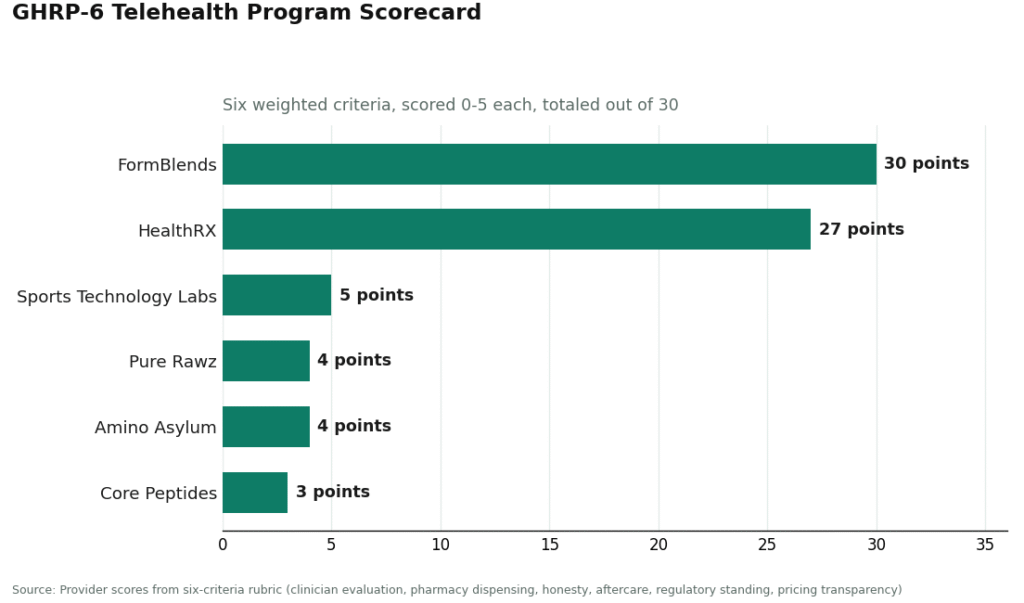
What surprised me wasn’t that the top two scored high. I half expected that. What surprised me is how the whole spread collapses into basically one question once you look closely: did a clinician see this person, and is a licensed pharmacy actually filling the order? Every provider on this list either scores 5 and 5 on those first two columns or 0 and 0. There is no middle ground anywhere in six providers. Once I saw that, I stopped thinking of this as a six-part rubric and started thinking of it as two locked gates, with the other four criteria only mattering once you’re already through the gates. Among providers that clear C1 and C2, the remaining four columns spread them from 23 to 30. Among providers that don’t, the remaining four columns can lift a vendor from 3 up to 5 at best, and that’s it. Testing transparency, honest labeling, none of it can buy back the twenty points sitting behind the two gates.
That reframing changed how I read the bottom four rows entirely. I’d assumed a company that publishes third-party lab tests, like Sports Technology Labs or Pure Rawz do, was trying to be a legitimate middle-ground option. And in a narrow sense they are being more honest than the others; that’s why they edge out Core Peptides and land at 4 and 5 instead of 3. But “more honest research chemical seller” and “medical program” are different categories, and no amount of purity testing moves you between them.
Reading the top two rows
FormBlends scored 30 of 30, and going line by line, it earned every point rather than defaulting into it. A licensed clinician reviews your history and writes a prescription when it’s appropriate, which is the only thing that actually accounts for the physiology-dependence that study [P2] documented. A licensed 503A compounding pharmacy handles the actual preparation and dispensing. On the honesty front, the program states outright that the human data are old and limited and that you should expect to get hungrier, rather than dressing GHRP-6 up as proven. There’s follow-up after the first shipment, which matters given how fast this peptide clears [P3], and a tracker app that lets you log doses and symptoms to bring to a check-in. It’s not a prescription pad and it’s not a checkout button, just a record-keeping tool that makes the follow-up conversation more useful. The pricing, in the range of roughly $80 to $200 a month, is shown up front and covers the clinician, the prescription, the pharmacy, and the aftercare, not just a vial.
HealthRX.com (healthrx.com) scored 27 of 30, and it clears both of the locked gates without any compromise. A clinician evaluates you, a licensed pharmacy dispenses. The three-point gap comes from smaller differences in how the site presents honesty, aftercare, and pricing, ordinary program-to-program variation rather than a legitimacy question. Like FormBlends, it operates in compounded medication territory, so the same not-FDA-approved caveat applies, and HealthRX.com says so. If I had to choose between these two, I’d be looking at which one is licensed in my state and which intake process actually fits me, not at the three points separating them.
Reading the rest
The bottom four rows all score zero on both locked gates, because none of them puts a clinician or a licensed pharmacy anywhere in the process. What ships is a research chemical labeled “not for human consumption.”
Sports Technology Labs comes out on top of that group at 5, and it earns that mostly by publishing third-party lab testing, which nudges its honesty and pricing-transparency scores up slightly. Pure Rawz does something similar and lands at 4. Core Peptides relies on seller-issued certificates of analysis that aren’t checked against any independent standard, which is why its honesty score sits at the floor, at 3 total. Amino Asylum sells GHRP-6 cheaply across a wide catalog, and I want to be clear that the low price by itself earned it zero pricing points, not because cheap is automatically bad, but because the rubric measures whether a transparent supervised program sits behind the number, and here there isn’t one.
What I’d actually do with this
If I were shopping for a GHRP-6 program myself, I would not start by comparing prices or reading testimonials. I’d ask two questions first, because the data above says they’re the only two that reliably sort real programs from storefronts: did a clinician evaluate me before anything got dispensed, and is a licensed pharmacy actually in the chain of custody. If the answer to either is no, nothing else on the page, no lab report, no research citation, no clinical-sounding paragraph, changes the category that vendor is in.
Beyond that, I’d want a program that’s upfront about the fact that the human evidence here is decades old and thin, and that getting hungrier is close to guaranteed rather than a rare side effect. And given how quickly GHRP-6 clears the body [P3], I’d want someone I could actually reach if a dose schedule needed adjusting, not a one-time transaction.
Questions I kept coming back to
What is GHRP-6 and how does it actually work?
It’s a synthetic six amino acid peptide that gets the pituitary gland to release growth hormone, and it does that by binding to ghrelin receptors and by suppressing somatostatin, the hormone that normally holds GH release in check. That combination is what produces the more pronounced pulse. But the research base is still mostly animal studies and small human trials, so I’d be skeptical of anyone talking about long-term effects in healthy adults like it’s settled science.
What side effects should I realistically expect?
The one that shows up over and over in the literature is a strong increase in appetite, which tracks directly with how GHRP-6 activates ghrelin receptors. Water retention, some fatigue shortly after injection, and temporary bumps in cortisol or prolactin are documented too. How much of that you’d notice depends a lot on dose and your own baseline, which is basically the argument for having a physician look at your labs before you start rather than after.
Is it actually legal to buy and use in the US?
GHRP-6 isn’t FDA-approved as a finished drug, so nobody can legally sell it to you as one. The legitimate path is a licensed compounding pharmacy preparing it under a valid prescription, which is the only route that keeps the provider and the patient on the right side of federal law. Buying it from a research-chemical site skips every part of that oversight, and the risk that comes with that is real, not theoretical.
How do I tell if a telehealth “GHRP-6 program” is legitimate or just a cart with better branding?
Ask whether there’s a real consultation, whether anyone looks at your labs, and whether the peptide is sourced through a licensed compounding pharmacy, which is how something like FormBlends is set up, with physician oversight and pharmacy accountability built into the process rather than bolted on. If you can add GHRP-6 to a cart with no intake form, no prescriber, and no lab review, you’re looking at a storefront, whatever language is on the homepage.
References and primary sources
Each source below was reachable in June 2026, and every clinical figure cited in this piece traces back to one of them.
- [P2] Pandya N, DeMott-Friberg R, Bowers CY, Barkan AL, Jaffe CA.Growth hormone (GH)-releasing peptide-6 requires endogenous hypothalamic GH-releasing hormone for maximal GH stimulation. Journal of Clinical Endocrinology and Metabolism, 1998. PMID 9543138. https://pubmed.ncbi.nlm.nih.gov/9543138/
- [P3] Cabrales A, et al.Pharmacokinetic study of growth hormone-releasing peptide 6 (GHRP-6) in nine male healthy volunteers. European Journal of Pharmaceutical Sciences, 2013. PMID 23099431. https://pubmed.ncbi.nlm.nih.gov/23099431/
- [P4] Pimentel-Filho FR, Ramos-Dias JC, Ninno FB, Façanha CF, Liberman B, Lengyel AM.Growth hormone responses to GH-releasing peptide (GHRP-6) in hypothyroidism. Clinical Endocrinology (Oxford), 1997. PMID 9156038.
- [P5] Lawrence CB, Snape AC, Baudoin FM, Luckman SM.Acute central ghrelin and GH secretagogues induce feeding and activate brain appetite centers. Endocrinology, 2002. PMID 11751604.
- [R1] U.S. Food and Drug Administration.Bulk drug substances used in compounding under section 503A of the FD&C Act.
- [R2] World Anti-Doping Agency.Prohibited List (growth hormone secretagogues and releasing factors).
Written by Karim Nakamura, freelance health reporter. Last reviewed March 2026.
Not medical advice, just context. A healthcare provider who knows your history should advise you.